
How much balloon décor do you actually need?
One of the first questions people ask when planning balloon décor is how much they need. There is no standard answer based purely on the number of guests or the size of the room. The right amount depends on where the balloons will be positioned, what they need to draw attention to and which parts of the event matter most.
A large venue does not necessarily need balloons in every corner. In fact, spreading a budget across too many small displays can make the overall result feel weak. A smaller number of well-planned focal points will usually create more impact, appear more consistently in photographs and make the venue feel intentionally decorated.
The aim is not to fill every available space. It is to identify the places where the décor will work hardest.
Start With the Guest Journey
Before deciding how many displays to order, think about how guests will experience the event.
Where will they arrive? What will they see first? Where will they gather, take photographs, watch presentations or spend most of the evening? Which areas will appear in professional photography and social media content?
These questions help establish the visual route through the event. Balloon décor can then be used to mark the most important points along that route rather than being distributed evenly without a clear purpose.
For a private celebration, the journey may move from an entrance display to a welcome sign and then towards the cake or dance floor. At a corporate event, it could begin at registration, continue through a branded entrance and finish at a stage, product display or networking area.
Not every point needs a separate balloon installation. The strongest locations should be prioritised according to the event and available budget.
Create an Entrance With Impact
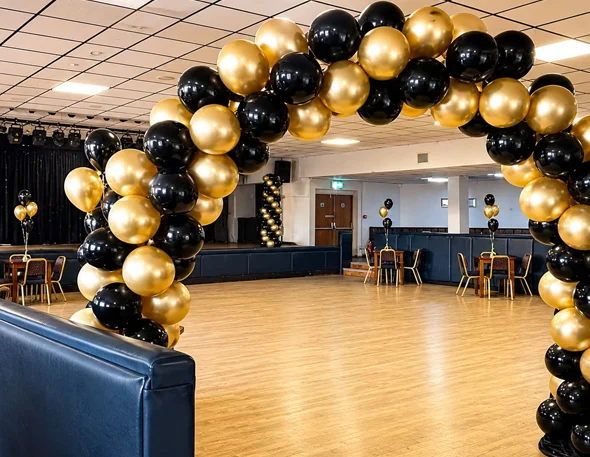
The entrance establishes the tone before guests have properly entered the event. A balloon arch, pair of towers or garland around a doorway can make the arrival feel deliberate and help guests identify that they are in the right place.
Entrance décor works particularly well for:
- Launch events and opening celebrations
- Awards evenings and corporate parties
- Birthdays, weddings and anniversaries
- Exhibition stands and trade events
- Venues with a plain or difficult-to-identify entrance
The scale should reflect the entrance itself. A full arch may be effective across a wide doorway, while a narrow entrance might be better suited to two towers or an asymmetrical garland. The display must not obstruct doors, emergency exits, pedestrian routes or venue signage.
If the entrance is visually strong but guests pass through it only once, it may not need to receive the largest share of the budget. Its importance should be balanced against features that will remain visible throughout the event.
Use the Welcome Area to Introduce the Event
A welcome area gives guests essential information and provides an early opportunity to reinforce the event theme or brand. It might include a personalised sign, seating plan, registration desk, directional signage or branded message.
A balloon garland around a welcome easel can be enough to create a polished feature without requiring a large installation. For corporate events, the colours can coordinate with the organisation’s branding, printed materials and digital displays. For private celebrations, the sign can include a name, age, date or message.
Because guests often pause at this point, the welcome area can also become an informal photography location. It should be positioned where people can stop without blocking the entrance or causing congestion.
If the venue already has an impressive entrance, investing in the welcome feature may produce more value than decorating both areas heavily.
Frame the Stage or Presentation Area
At conferences, launches, awards evenings and corporate events, the stage is often the main visual focus. Guests face it for extended periods, speakers are photographed there and it may appear in most of the event’s video content.
Balloon décor can be used to frame the stage, soften a technical setup or bring event colours into the presentation area. Options could include two matching towers, an organic garland positioned around a backdrop or a larger installation integrated with signage and lighting.
The balloons should support the stage rather than compete with it. They must not block screens, logos, lighting, speakers or sightlines. The size of the display also needs to be judged from the audience’s viewing distance. A small arrangement that looks substantial during installation may disappear once seen from the back of a large room.
When the stage is central to the event, it is usually better to create one properly scaled installation there than divide the same budget among several less important areas.
Make the Cake Table a Focal Point
At birthdays, weddings, baby showers and other celebrations, the cake table naturally attracts attention. Guests gather around it, key photographs are taken there and it often provides the visual centre of the room.
A garland, circular frame, backdrop or personalised stack can turn the cake area into a complete feature. The design should frame the table without hiding the cake, signage or other important details.
The proportions matter. A wide table against a large wall may require a substantial backdrop and garland, while a smaller table can be overwhelmed by too much décor. The display should be designed around the actual table dimensions and the amount of space available around it.
If the cake table will be used for photographs, allow enough width and height for people to stand beside it. A design that only frames the cake may not work as a guest backdrop.
Define the Dance Floor Without Restricting It
The dance floor is another area where balloon décor can add energy and make the venue feel more complete. Arches, towers or installations positioned near the DJ area can help define the space and connect it visually with the rest of the event.
This area needs to be planned carefully. Balloons and support structures should not reduce the usable dance floor, interfere with lighting equipment or create a trip hazard. Décor positioned too close to speakers, moving lights or busy service routes can also create practical problems.
It is rarely necessary to surround the entire dance floor with balloons. One strong feature behind the DJ, at the entrance to the floor or beside the main entertainment area can provide enough visual definition without overcrowding the space.
Plan a Dedicated Photography Point
If photographs are important, create a location specifically for them instead of assuming guests will find an attractive background elsewhere.
A photography point can combine balloons with a printed backdrop, tension fabric wall, circular frame, personalised sign or branded display. It should be large enough for the expected group size and positioned where there is sufficient space for both the subjects and the photographer.
Consider what will be visible through the camera. Fire doors, storage areas, venue notices, cables and passing staff can undermine an otherwise strong display. Lighting is equally important. A dark corner may appear convenient during planning but produce poor photographs on the day.
For corporate events, a dedicated photography point can also increase the visibility of logos, sponsors and campaign messages. It gives guests a clear place to create content while keeping the branding consistent across shared images.
Because a photography backdrop can generate value long after the event has ended, it is often a stronger investment than several small displays that will rarely be photographed.
Prioritise the Areas That Matter Most
Most events have a practical limit on space, installation time and budget. The solution is to rank the focal points rather than trying to decorate all of them equally.
A useful order of priority is:
- The main event feature: The stage, cake table, product display or principal photography backdrop.
- The arrival point: The entrance, registration area or welcome sign.
- The secondary experience: The dance floor, bar, networking area or another location guests will use repeatedly.
This order will change according to the event. At an awards evening, the stage may dominate. At a birthday, the cake and photography area could be the same feature. At an exhibition, the entrance may be irrelevant because the stand itself must attract attention from the aisle.
Combining functions is often the most efficient approach. A welcome backdrop can display the event name, provide a photography point and introduce the colour scheme in one installation. A cake display can also become the main guest backdrop. This concentrates the visual effect and reduces the need for separate displays.
Why Spreading the Budget Too Thinly Can Weaken the Result
Several small arrangements may sound like more décor, but they do not always produce more impact. In a large room, small displays can become visually disconnected and fail to establish a clear focal point.
Each installation also involves materials, preparation, transport and setup. Dividing the budget across numerous locations may reduce the scale and finish of every display without creating a stronger overall scheme.
One substantial installation is more likely to be noticed, remembered and photographed. Supporting it with one or two smaller coordinated features can then carry the theme through the venue without competing for attention.
This does not mean every event needs a large or expensive balloon installation. A well-positioned easel garland or personalised stack may be entirely appropriate for a smaller room. The issue is not quantity alone; it is whether the scale and placement make sense within the surroundings.
Match the Décor to the Venue
Venue photographs, measurements and floor plans help a balloon supplier judge how much décor the space can carry. Ceiling height, wall colour, furniture, lighting and existing architectural details all affect the result.
A visually busy venue may need fewer, more controlled features. A plain event space may benefit from a larger installation that introduces colour and structure. Outdoor settings require additional consideration because weather, wind and anchoring can affect the size and type of display that can be installed safely.
The number of guests matters mainly because it affects how the room will be used. A crowded venue needs clear movement routes, while a larger room with fewer guests may require the décor to help define the occupied areas.
There Is No Standard Amount of Balloon Décor
The right amount of balloon décor is the amount needed to make the important areas feel intentional. It should direct attention, support the purpose of the event and appear where guests will actually experience it.
Start with the main focal point, add an arrival feature if it contributes to the event and then consider whether another area genuinely needs support. This produces a more coherent result than attempting to place balloons everywhere.
Event Decor Studio plans and installs balloon décor for private celebrations, corporate events, launches and exhibitions across Liverpool and the North West. Each display is designed around the venue, event priorities and available space.